Thursday Oct 15, 2026
Thursday Oct 15, 2026
Tuesday, 24 February 2026 02:16 - - {{hitsCtrl.values.hits}}
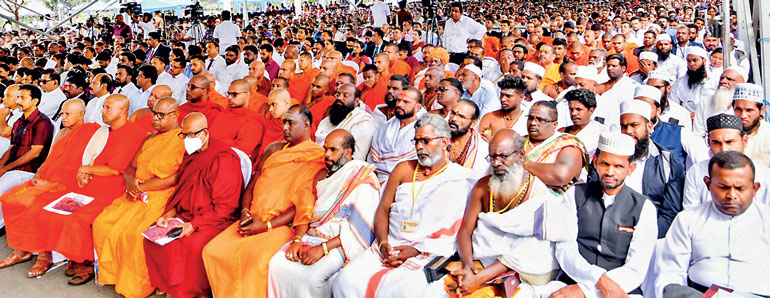
 As citizens, we must realise that this country will never develop into a state of peace and prosperity so long as the evil of racism and racist attitudes persist among the people.
Sociological and anthropological studies show that prejudice against “others” is an innate human trait in its crude form. Therefore, to single out the Sinhala people alone as racists will be unfair because these attitudes are prevalent even among the Tamils and Muslims. The difference is the scope and extent of such attitudes appear more pronounced within certain segments of the Sinhalese people. Unlike the crude form, modern day racism is different as it is built on power, inequalities, domination and discrimination. The reasons are multiple and interrelated. These include the Sinhalese population being in the majority, Sinhalese ethno-nationalism, the “Sinhala Buddhist” narrative, competing “historical” claims made by them, the use and abuse of monks and temples, the servile political mindset.
Anura’s pledge
President Anura Dissanayake’s speeches on racism before and after elections is beyond reproach. We believe in his sincere desire to take the bull by the horn - a cancer that has retrogressed this nation by several decades. However, mere speeches and sincerity alone will not suffice. These have to be backed by measurable affirmative action and consistent enforcement to feel the change.
The prevalence of racism and racist attitudes is not unique to Sri Lanka.
Racism in its different variations have been seen in the United States, Europe, Australia and in the Asian continent – particularly, worst in India. The evil precursors were the institutionalised slavery and segregation in the United States, apartheid era in South Africa and racial hierarchies created by the colonialist British empire.
In the local context, these dynamics evolved into the Sinhala Buddhist majority religio-political thought reinforced by the 1972 and 1978 constitutional provisions granting Buddhism the foremost place and State protection. Professor Nihal Jayawickrema wrote: “By explicitly creating a special status for Buddhism, the constitution has produced the category of ‘The Other’. The creation of this distinction has a potential to discriminate in a pluralistic society and to undermine the fundamental principle of equality. He continued to note that there was room for conflict when the State proceeded to afford such a special place for Buddhism in practice. (Reflections on the Making and the Content of the 1972 Constitution: An Insider’s Perspective).
 President Anura Dissanayake’s speeches on racism before and after elections is beyond reproach. We believe in his sincere desire to take the bull by the horn - a cancer that has retrogressed this nation by several decades. However, mere speeches and sincerity alone will not suffice. These have to be backed by measurable affirmative action and consistent enforcement to feel the change
Will the NPP abolish Article 9?
This Article enshrined in the Constitution gives legal validity to majoritarian nationalism and administrative bias against the minority citizens. As a first step, will the present NPP Government consider abolishing Article 9 of the present Constitution, to bring about equality amongst the citizens. By its own confession, it seems a far cry. In 2016, when the whole House was converted into a Constitutional Assembly by the then Government, to make a new constitution, Article 9 was considered. Submissions were made by all parties and civil organisations regarding this. Though the JVP supports a secular constitution and the policy that there should not be state patronage for any religion, it did not make any proposal regarding Article 9. Interestingly, JVP MP Bimal Ratnayake at the debate said that the Government or any party in power would not risk its political stability by altering Article 9. (Constitutional Assembly (Official Report, 30 Oct 2017), 83-84).
The result of the opportunistic and chauvinist policy of the Sinhalese politicians who created this abyss of Article 9 is that any Government in power is constantly intimidated by politically motivated racist monks. In November 2025 the removal by Police of a Buddha statue in Trincomalee placed in violation of the Coastal Conservation Laws created a significant communal tension. The arrest and detention of some monks were condemned by the higher clergy. This incident highlights the fact that when the rule of law is established and if it involves monks, they want special treatment on the basis of Article 9. They provide an extended interpretation of this Article and wish for privileges above the law.
Is the President aware?
Thus, with no hope for a change in Article 9, what can those who voted the Government to power and the citizens in general expect President Dissanayake to do in this regard? At least the hope is that President Dissanayake is aware of what he is talking about. We do not doubt his sincerity when he says, “We will never allow racism in any form to raise its head again.” The fact is that racism can never be eradicated but it can only be significantly reduced.
Will the present NPP Government consider abolishing Article 9 of the present Constitution, to bring about equality amongst the citizens
Achieving meaningful progress requires sustained intervention at multiple levels: coherent Governmental policy reform, institutional restructuring to ensure inclusivity, consistent enforcement of anti-discrimination laws, and educational reforms that promote pluralism while critically re-examining exclusionary historical narratives. In the Sri Lankan context, while certain legal and constitutional guarantees of equality exist, the extent to which these commitments have been implemented in a systematic and structurally transformative manner remains open to scrutiny. Symbolic rhetoric against racism, or the suppression of isolated incidents of ethnic hostility, cannot substitute for deep institutional change and long-term policy consistency.
Disparities continue
What is experienced is disparities in education, health and employment, ethnic profiling in matters of security policies, marginalising the minority in political representation and governance matters.
Some of the main drivers of racism can be classified into:
 Politics – by structuring minorities into demographic, cultural, or as security threats. This helps to polarise ethnic groups.
Economics – Create a threat perception that certain minorities dominate the trade sectors, substituting competition with boycotting. Aimed at ‘othering’ the minority community. Ignoring the contribution made by the minority to the economy.
Monks – Opportunistic radical Buddhist monks acting on their own or at the behest of somebody. A potent manifestation of power and dominance enjoyed by the monks arising from misplaced blind allegiance to the saffron cloth they wear.
Though the JVP supports a secular constitution and the policy that there should not be State patronage for any religion, it did not make any proposal regarding Article 9. Interestingly, JVP MP Bimal Ratnayake at the debate said that the Government or any party in power would not risk its political stability by altering Article 9. (Constitutional Assembly (Official Report, 30 Oct 2017), 83-84)
Religion – The entrenched Article 9 constitutionally elevates Buddhism to a privileged status. Effectively, relegating other religious beliefs to a secondary level. The phrase “protect and foster” is open-ended. It paves the way for manipulative and deceitful interpretation of the Article favouring the belligerents.
Cultural – the negative portrayal of symbols associated with dress, food, places of worship aimed at fostering irrational and prejudicial denial.
Social media – Digital platforms accelerate spread of misinformation, hate speech and echo chambers foster polarisation and extremism.
It is clear that racism is neither dead nor dying in this land where both the laity and clergy boast of the Dhamma. Ironically, it is alive and kicking with certain notorious groups of monks identified as the perpetrators. Racism can be experienced on a daily basis one way or the other – covertly or overtly, loudly or in whispers, subtly or obviously and disparities do exist. Law cannot eliminate prejudice because the latter is more of a mental attitude. Therefore, initiatives that will reform behavioural patterns like outlook, perception, belief and stereotyping have to be adopted.
Achieving meaningful progress requires sustained intervention at multiple levels: coherent Governmental policy reform, institutional restructuring to ensure inclusivity, consistent enforcement of anti-discrimination laws, and educational reforms that promote pluralism while critically re-examining exclusionary historical narratives
We are waiting, Mr. President.
(The author is an Attorney at Law and an ex-Corporate and Legal Adviser.)




